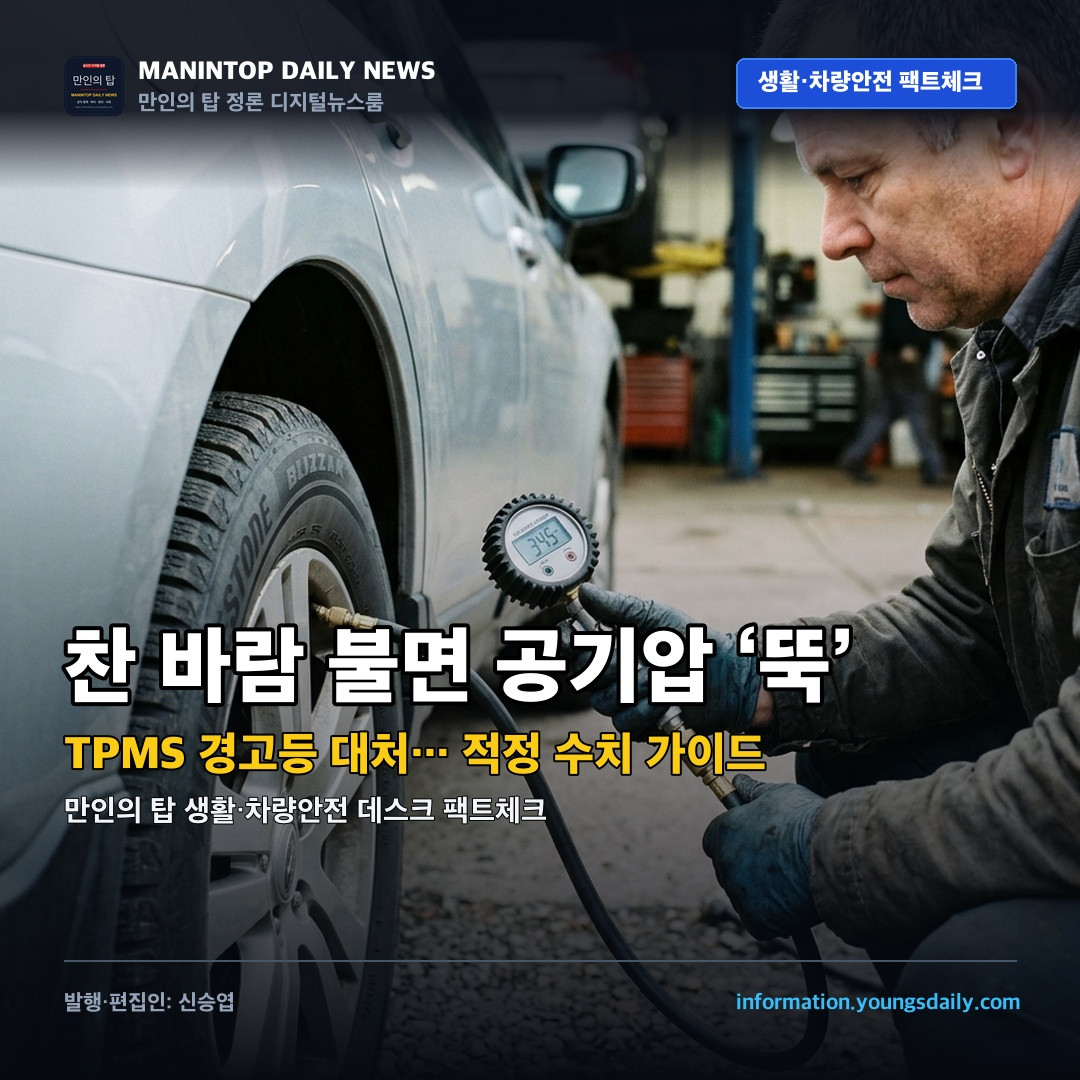
▲ 찬 바람 불면 왜 타이어 공기압 뚝 떨어질까… TPMS 경고등 대처법과 겨울철 적정 수치 관리 가이드 / 만인의 탑 만인의 탑 생활·차량안전 데스크 팩트체크
📌 만인의 탑 핵심 브리핑 · 이 글에서 다루는 핵심 내용
기온이 급강하하는 가을·겨울 환절기에 발생하는 타이어 공기압 수축의 물리적 메커니즘(샤를의 법칙)과 계기판 TPMS 경고등 점등 시 대처법, 운전석 B필러 기준 냉간 적정 공기압 확인 및 5~10% 보정 주입법, 고속주행 스탠딩 웨이브 파열 방지를 위한 월 1회 점검 수칙을 심층 취재하여 보도합니다.
SPONSORED · ADVERTISEMENT
1. 찬바람과 기온 급강하에 따른 공기압 자연 누출의 물리학 (샤를의 법칙)
타이어 내부 공기는 밀폐된 고무 튜브 속 기체로, 이상기체 상태방정식(PV=nRT) 및 샤를의 법칙에 따라 기온 변화에 정직하게 반응한다. 밀폐된 일정한 부피(V) 안에서 기체의 절대온도(T)가 떨어지면 기체 분자들의 열운동 에너지가 감소하여 타이어 내부 벽면을 밀어내는 충돌 횟수와 압력(P)이 비례하여 낮아진다. 자동차 공학계 실측 데이터에 따르면 외부 대기 온도가 10℃ 하강할 때마다 타이어 공기압은 약 1~2 PSI (약 0.07~0.14 bar)씩 물리적으로 감소한다. 지난여름 30℃ 안팎의 무더위 속에서 36 PSI로 주입했던 타이어는 가을을 지나 기온이 0℃ 부근으로 급랭하는 초겨울 아침에 주행을 시작하기도 전에 이미 3 PSI 이상 빠져 32~33 PSI로 주저앉게 된다.
여기에 타이어 고무 특유의 고유 물성이 결합된다. 타이어를 구성하는 합성 고무 소재는 겉보기에는 완벽한 밀폐막 같지만 미세 분자 구조상 극미한 기공을 지니고 있어, 정상 상태의 신품 타이어라도 매달 1~2 PSI(전체 압력의 약 1~3%)의 공기가 림 결합부와 미세 기공을 통해 자연 누출된다. 여름철 이후 몇 달 동안 공기압 점검을 한 번도 하지 않은 차량이라면 기온 급강하에 따른 물리적 수축량과 수개월간 누적된 자연 누출량이 합산되어, 초겨울 첫 한파가 닥쳤을 때 원래 규격 수치 대비 5~8 PSI 이상 밑도는 위험한 과소 공기압 상태로 노출되는 것이다.
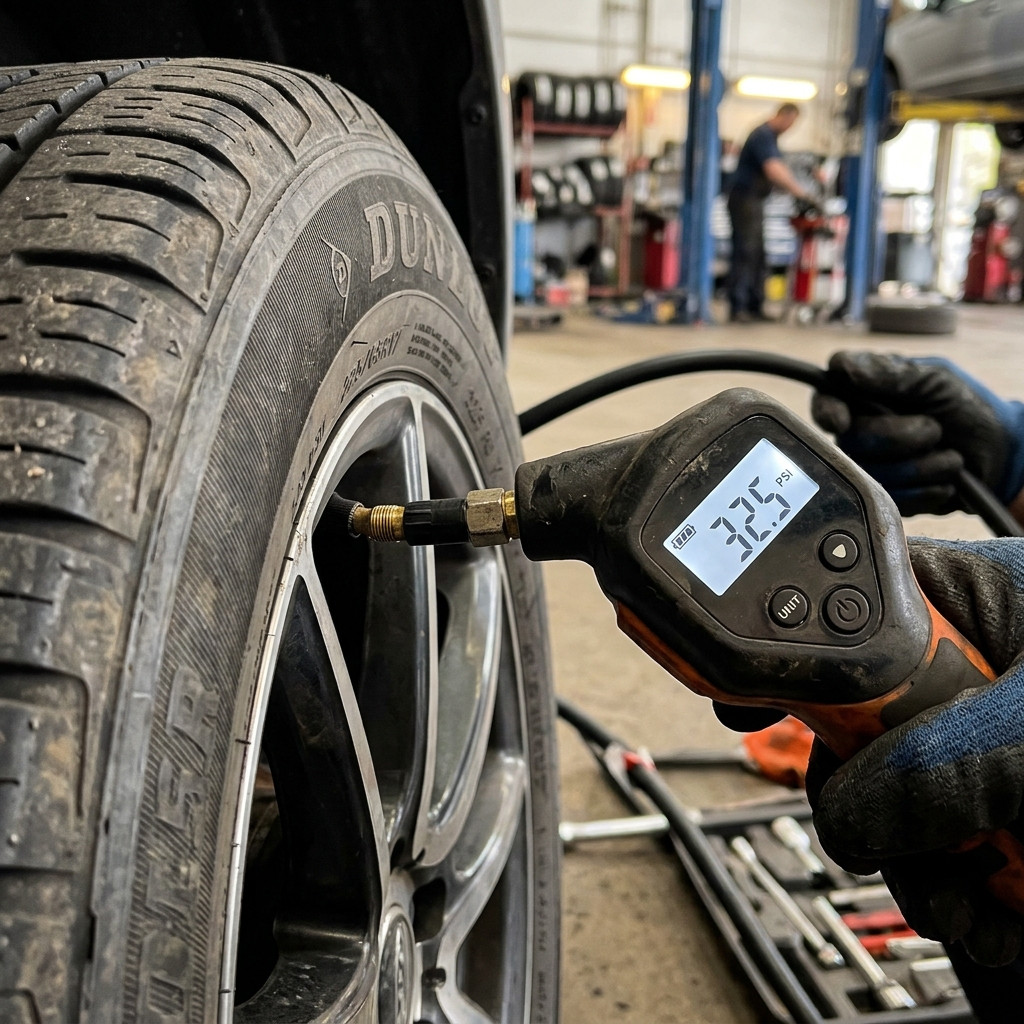
▲ 디지털 타이어 공기압 측정 주입기 노즐 체결 및 공기압 정밀 판독 / 만인의 탑
2. TPMS 노란색 경고등 점등 메커니즘과 즉각적인 현장 응급 조치 요령
자동차 계기판에 노란색 타이어 단면과 느낌표(!)가 그려진 경고등이 켜지는 장치는 '타이어 공기압 모니터링 시스템(TPMS: Tire Pressure Monitoring System)'이다. 대한민국에서는 2013년 1월부터 승용차에 의무 장착되었으며, 2015년부터는 총중량 3.5톤 이하 모든 전 차종으로 의무화가 확대되었다. TPMS의 경고등 점등 알고리즘은 제조사 권장 적정 공기압 대비 20%~25% 이상 압력이 떨어질 때 즉각 운전자에게 위험을 알리도록 법제화되어 있다. 예를 들어 적정 냉간 공기압이 36 PSI인 차량의 경우, 어느 한 바퀴라도 압력이 약 27~28 PSI 밑으로 내려가면 계기판에 노란색 경고등이 점등된다.
아침 출근길 시동을 켰을 때 TPMS 경고등이 들어왔다면 가장 먼저 '직접식(Direct)'과 '간접식(Indirect)' 시스템의 작동 특성을 인지하고 침착하게 대처해야 한다. 휠 밸브 안쪽에 전자식 압력 센서가 내장된 직접식 TPMS 차량의 경우 계기판 트립 메뉴에서 네 바퀴의 실시간 공기압 수치를 숫자로 확인할 수 있다. 만약 네 바퀴 모두가 27~29 PSI 수준으로 균일하게 떨어져 있다면 펑크가 아니라 밤사이 기온 급강하로 인한 전체 공기압 수축이 원인이다. 반면 3개 바퀴는 32 PSI인데 유독 특정 바퀴 하나만 20 PSI 이하로 곤두박질치고 있다면 못이나 나사 찔림에 의한 실펑크(Slow Puncture)이므로 즉시 안전한 갓길에 정차하여 육안 점검을 해야 한다. 주행을 시작하면 타이어 내부 공기가 마찰열로 데워져 2~3 PSI가량 일시 팽창하며 경고등이 저절로 꺼지기도 하지만, 이는 일시적인 열팽창 착시일 뿐 본질적인 공기량 부족 상태가 해소된 것이 아니므로 당일 즉시 공기압을 규격치로 보충해야 한다.
구분 항목
적정 공기압 유지 시
공기압 부족 (과소 공기압)
공기압 과다 (과주입 상태)
접지면 형태
트레드 전면이 노면에 고르고 평평하게 밀착
중앙부 들뜸, 양쪽 숄더(가장자리) 집중 마모
중앙부만 볼록 팽창, 중앙 트레드 집중 조기 마모
제동력 및 조종성
설계 제동거리 충족, 최적 코너링 접지력
제동거리 급증, 빗길·눈길 수막현상 급격 악화
접지면적 축소로 제동거리 증가, 차체 튀는 승차감
고속주행 안전성
고속 회전 시 변형 억제, 주행 안정성 유지
스탠딩 웨이브 발생으로 고속도로 파열(Blowout) 위험
노면 충격 완충 불가, 포트홀 충격 시 코드 절손 위험
연비 및 내구성
제조사 공인 표준 연비 및 수명 100% 발휘
구름저항 급증으로 연비 3~5% 악화, 발열 파손
연비는 소폭 개선되나 타이어 조기 교체 비용 발생
SPONSORED · ADVERTISEMENT
3. 운전석 B필러 라벨 확인법과 겨울철 +5~10% 보정 가이드
타이어에 공기를 얼마만큼 넣어야 하는가에 대해 많은 운전자들이 타이어 옆면(Sidewall)에 양각으로 적힌 'MAX PRESS 44 PSI' 또는 '50 PSI'를 보고 그에 맞추거나 어림짐작으로 주입하는 오류를 범한다. 사이드월에 적힌 숫자는 타이어가 견딜 수 있는 '절대 한계 최대 허용 압력'일 뿐 차량 제조사가 차량 무게, 서스펜션 댐핑, 접지면 설계를 고려해 계산한 적정 공기압이 절대 아니다. 공인 단일 진실(Ground Truth)은 반드시 운전석 도어를 열었을 때 차체 기둥 프레임에 부착된 '공기압 제원 스티커(B-Pillar Placard)'에서 확인해야 한다.
B필러 스티커에는 해당 차량의 순정 타이어 규격(예: 235/45R18)과 함께 전륜(Front)과 후륜(Rear)의 '냉간 적정 공기압(Cold Tire Inflation Pressure)'이 PSI 및 kPa 단위로 정밀하게 명시되어 있다. 일반적으로 국산 중형 세단 기준 33~36 PSI, 대형 SUV의 경우 35~38 PSI가 표준이다. 여기서 중요한 안전 원칙은 기온이 급강하하는 11월부터 2월 사이의 동절기에는 제조사 권장 표준 냉간 수치보다 '5%에서 10%(약 2~3 PSI)' 높여 주입하는 것이 교통안전 전문가들의 일치된 권고다. 겨울철 낮에 정비소에서 따뜻한 실내 온도나 주행 직후 보충한 공기는 밤사이 영하 10℃의 혹한에 노출되면 다시 수축하여 규격치 이하로 떨어지기 때문에, 미리 2~3 PSI의 안전 버퍼(Buffer)를 확보해 두어야 한겨울에도 상시 적정 접지면과 제동 성능을 방어할 수 있다.
공기압이 부족한 상태로 고속도로를 시속 100km/h 이상 질주하는 것은 시한폭탄을 달고 달리는 것과 같다. 타이어 공기압이 20% 이상 부족해지면 차체 하중을 지탱하지 못해 타이어가 납작하게 찌그러지며 노면과 닿는 접지면이 불필요하게 넓어진다. 이 상태에서 고속 회전을 지속하면 접지면에서 찌그러진 타이어 고무가 미처 원래 형태로 복원되기도 전에 다시 노면을 치고 도는 과정이 초당 수십 회 반복되면서, 트레드 뒷부분이 물결처럼 요동치는 '스탠딩 웨이브(Standing Wave)' 현상이 발생한다.
스탠딩 웨이브가 발생하면 내부 고무와 보강재 카커스(Carcass) 코드 간에 극심한 마찰열이 축적되어 내부 온도가 120℃ 이상으로 치솟는다. 이 열기로 인해 고무와 스틸 벨트 접착면이 녹아내리면서 주행 중 타이어가 폭탄처럼 산산조각 파열(Blowout)되는 참사로 직결된다. 특히 겨울철에는 눈길·빙판길 접지력을 높인다는 잘못된 민간요법을 믿고 일부러 공기압을 빼고 주행하는 운전자들이 있으나, 이는 타이어 트레드의 배수 홈(Groove)을 압착시켜 수막현상(Hydroplaning)과 슬립을 배가시키는 극도로 위험한 행위다. 따라서 반드시 타이어가 식어 있는 상태(주행 전 또는 주행 후 3시간 이상 경과한 '냉간 상태')에서 차량 트렁크에 비치된 휴대용 공기압 주입기나 가까운 주유소·셀프세차장 주입기를 이용해 월 1회 주기적으로 점검·보충하는 습관이 생명을 지키는 기본 수칙이다.
RECOMMENDED STORIES · SPONSORED
▲ Official Press Coverage & Contextual Archive / MANINTOP Global Newsroom
MANINTOP GLOBAL NEWSROOM · ENGLISH EDITION
Why Tire Pressure Drops Drastically in Cold Weather: TPMS Warning Light Response and Winter Cold PSI Management Guide
As autumn transitions into early winter and morning ambient temperatures drop into single digits, millions of drivers across the country find themselves confronted by the ominous illuminated yellow horseshoe icon on their instrument clusters: the Tire Pressure Monitoring System (TPMS) warning light. While many immediately fear a puncture or nail embedded in their treads, the overwhelming majority of seasonal alerts stem from the natural physics of gas contraction governed by Charles's Law. With every 10°C drop in ambient temperature, internal tire air pressure decreases by 1 to 2 PSI (approximately 3 to 4 percent). Coupled with natural molecular permeation through rubber membranes, unmaintained tires can easily lose more than 20% of their rated pressure by early winter. Based on rigorous automotive maintenance engineering standards and Korea Transportation Safety Authority protocols, this investigation provides a deterministic guide to TPMS alerts, proper B-pillar cold inflation standards, winter buffer calibration, and the prevention of catastrophic high-speed standing wave blowouts.
📌 Key Takeaways
Verified factual reporting regarding Why Tire Pressure Drops Drastically in Cold W.
In-depth contextual and institutional analysis by MANINTOP Global Newsroom.
Official implementation schedule and verifiable public guidelines confirmed.
1. Charles's Law and the Physics of Seasonal Atmospheric Pressure Drops
Air inside an automotive tire represents an enclosed gas subject to the ideal gas law (PV=nRT) and Charles's Law. Within a fixed volume (V), as the absolute temperature (T) of the gas decreases, the kinetic energy of air molecules drops, reducing the frequency and velocity of molecular collisions against the inner tire liner and resulting in a proportional decline in pressure (P). Empirical automotive engineering measurements confirm that for every 10°C decrease in ambient temperature, tire inflation pressure contracts by approximately 1 to 2 PSI (0.07 to 0.14 bar). A tire inflated to 36 PSI during sweltering 30°C summer conditions will naturally drop by over 3 PSI on a crisp 0°C early winter morning before the vehicle even turns a wheel.
Compounding this thermodynamic contraction is the intrinsic permeability of vulcanized synthetic rubber. Although seemingly impervious, tire rubber contains microscopic pores through which gas molecules slowly escape over time, causing an inherent natural leakage rate of 1 to 2 PSI per month even on brand-new, defect-free wheel assemblies. When an unmaintained vehicle enters the cold season without routine quarterly checks, the combined effects of cumulative molecular diffusion and rapid thermal contraction drop tire pressures 5 to 8 PSI below manufacturer specifications, placing the vehicle in a hazardous under-inflated condition.
2. TPMS Warning Light Architecture and Practical Triage Protocols
The illuminated yellow dashboard symbol depicting a tire cross-section with an exclamation mark is the Tire Pressure Monitoring System (TPMS). Mandated in South Korea on passenger vehicles since January 2013 and across all light commercial vehicles under 3.5 tons since 2015, TPMS algorithms are legally programmed to alert the operator when inflation pressure falls 20% to 25% below the manufacturer's recommended cold baseline. For a passenger vehicle requiring 36 PSI, the threshold triggers when any single tire dips below roughly 27 to 28 PSI.
Upon observing a TPMS alert upon cold startup, drivers must distinguish between Direct and Indirect monitoring systems to execute proper triage. Direct TPMS architectures incorporate wireless electronic pressure sensors inside the valve stems, displaying real-time digital PSI figures for each individual tire on the instrument cluster. If all four tires simultaneously register 27~29 PSI, the root cause is uniform seasonal thermal contraction rather than road hazard damage. Conversely, if three tires register 33 PSI while one corner has plunged below 20 PSI, a mechanical slow puncture from a nail or screw is the definite culprit, requiring immediate roadside inspection. While driving generates friction that temporarily warms the tire carcass and expands the air by 2~3 PSI—sometimes extinguishing the warning light temporarily—this thermal expansion is merely a transient illusion; the baseline air mass remains depleted and demands immediate reinflation to factory specifications.
3. Decoding the Driver-Side B-Pillar Placard and the +5~10% Winter Buffer
A pervasive and dangerous error among everyday motorists is determining inflation targets from the embossed text on the tire sidewall, such as 'MAX PRESS 44 PSI' or '50 PSI'. The sidewall inscription represents the maximum permissible mechanical burst pressure the structural carcass can tolerate under maximum load; it is never the engineered operating pressure calculated for the vehicle's specific curb weight distribution, suspension geometry, and braking dynamics. The single deterministic ground truth for inflation is permanently riveted to the driver-side door jamb or B-pillar frame placard.
The OEM B-pillar certification sticker precisely lists the original equipment tire dimensions (e.g., 235/45R18) alongside factory-specified front and rear 'Cold Tire Inflation Pressure' in both PSI and kPa. Typically, mid-size sedans specify 33 to 36 PSI, while heavier SUVs designate 35 to 38 PSI. During the winter months from November through February, transportation safety engineers universally recommend inflating tires to 5% to 10% (approximately 2 to 3 PSI) above the baseline B-pillar rating. Because daytime inflation performed inside heated service bays or immediately following driving will contract significantly when parked outdoors overnight in sub-zero temperatures, this 2~3 PSI buffer guarantees that operating pressures never sink below minimum safety tolerances during extreme morning cold snaps.
4. Standing Wave Blowout Mechanics and the Rigorous Monthly Cold-Check Mandate
Sustained highway travel above 100 km/h on under-inflated tires exposes the vehicle to extreme blowout risks. When internal pressure drops 20% or more, the tire sidewall collapses under vehicle weight, abnormally spreading the contact footprint. Under high-speed rotational velocities, the heavily deflected tire rubber fails to recover its original circular profile before encountering the pavement again. This continuous delay sets up severe resonant harmonic vibrations along the trailing edge of the contact patch, a destructive phenomenon known as a 'Standing Wave'.
A standing wave concentrates enormous friction within the rubber tread and internal carcass cords, causing internal temperatures to skyrocket past 120°C in minutes. This extreme thermal stress disintegrates the bonding adhesives between the synthetic rubber and steel plies, culminating in sudden, explosive carcass blowout and catastrophic loss of vehicular control. Furthermore, the persistent myth that lowering tire pressure improves winter snow traction is dangerously erroneous for modern radial tires; under-inflation pinches circumferential sipes and drainage grooves closed, severely degrading snow evacuation and dramatically increasing slush hydroplaning. Routine monthly pressure inspections conducted strictly under 'cold' conditions—prior to driving or at least three hours after parking—using an accurate digital tire inflator represent an indispensable life-saving habit.
Category
Optimal Pressure (OEM Baseline)
Under-Inflation (Low PSI)
Over-Inflation (Excessive PSI)
Ground Shape
Tread front evenly and flat against surface
Central lifting, central wear on both shoulders (edges)
Central part only convex expansion, central tread focus premature wear
Computer Programmer who love programming.
Computer Programmer Who love Riding Bicycle.
Computer Programmer who love trip in abroad.
Computer Programmer who love studying about programming
- even if sometimes it's very boring.
Computer Programmer who love talking with person.
- I love communication with person.
1월이 시작되면 감기는 이미 우리 곁에 와 있습니다. 2월, 3월, 4월까지 이어지는 추위와 건조함은 코와 목을 가장 먼저 공격합니다. 아침에 일어나자마자 막혀 있는 코. 계속 흐르는 콧물. 괜히 칼칼해지는 목. 이 증상은 “시작”일 뿐입니다. 한 번 무너지면 일주일, 길면 한 달까지 끌고 갑니다. 약을 먹으면 잠깐 괜찮아집니다. 하지만 며칠 뒤 또 반복됩니다. 왜일까요? 감기는 ‘치료’의 문제가 아니라 ‘관리’의 문제이기 때문입니다. 대부분은 감기가 오고 나서 약을 찾습니다. 하지만 진짜 중요한 건 감기가 오기 전에 코와 목을 지키는 것입니다. 건조한 실내 공기, 차가운 바깥 공기, 눈에 보이지 않는 세균. 코와 목은 매일 공격받고 있습니다. 지긋지긋하죠! 그런데도 우리는 아무 준비 없이 버티고 있습니다. 이번 겨울도 그렇게 보낼 건가요? 사실 방법은 어렵지 않습니다. 코를 깨끗하게 관리하고, 목을 따뜻하게 보호하고, 점막을 촉촉하게 유지하고, 기관지를 미리 관리하고, 외부 공기를 차단하는 것. 이 다섯 가지만 꾸준히 해도 감기약 없이 겨울을 보내는 것이 충분히 가능합니다. 🔥 이제부터 그 방법을 하나씩 살펴보겠습니다. 🔥 1. 코와 목을 먼저 관리해야 하는 과학적 이유 감기의 대부분은 코 점막에서 시작됩니다. 국제 학술지 Nature Reviews Microbiology 와 Journal of Allergy and Clinical Immunology 에 실린 호흡기 감염 관련 연구들에서는, 감기 바이러스가 비강 상피세포에 먼저 부착해 증식한다는 점을 설명하고 ...
리모델링사업이 진행 중인 아파트를 매매할 때 “계약금 10%를 언제까지 내야 하느냐”는 질문이 특히 많이 나옵니다. 이주공고(이주 안내)가 7~11월쯤이라고 들으면, 그 시점에 맞춰 계약금도 움직일 것 같아서 더 헷갈리기 쉽습니다. 하지만 실제 납부기한은 ‘이주공고가 언제냐’만으로 자동 결정되지 않는 경우가 많습니다. 1) 계약금 10% 납부기한: 결국 ‘문서에 적힌 일정’이 기준 계약금 10%를 언제까지 납부해야 하는지는, 내가 서명하는 매매계약서(특약 포함) 와 사업주체/조합이 제시한 공고·안내문 에 적힌 납부 일정이 기준이 됩니다. 실제 공고문에서는 분양대금 납부의 큰 틀(계약금→중도금→잔금)을 먼저 안내하고, 상세 일정은 별도 표나 유의사항으로 제시하는 방식이 흔합니다. 또, 계약서 문구에 따라 지급 시점이 조건부로 설정될 수도 있습니다. 예를 들어 한 사례 소개 자료에서는 용역계약서에 잔금(10%) 지급시기가 “사업승인 후”로 기재되어 있었다는 점이 언급됩니다. 이런 식으로 ‘사업 단계’와 지급을 연동하는 문구가 들어가면, 질문의 답은 계약서 문구를 확인해야만 확정됩니다. 관련 내용은 링크 에서 문구 사례를 확인할 수 있습니다. 2) 입주자모집공고에서 확인되는 ‘납부 순서’와 잔금 마감 시점 공고문에 적힌 문구를 보면, 납부 순서와 잔금 마감에 대한 기준이 비교적 명확하게 제시되는 경우가 있습니다. 예를 들어 한 입주자모집공고에는 “분양금액(주택가격)은 계약금, 중도금, 잔금의 순서로 납부”하며 “잔금은 입주(열쇠 수령일) 전에 완납”해야 한다고 안내되어 있습니다. (문구 확인: 링크 ) 이 문구가 의미하는 바는 최소 2가지입니다. 분양/공급 형태의 문서에서는 ‘계약금→중도금→잔금’ 흐름이 공식적으로 안내될 수 있습니다. 잔금은 “입주(열쇠 수령)” 이전에 완납해야 한다는 마감 기준이 문서에 적혀 있을 수 있습니다. 다만, 위 공고문 문구는 잔금 마감에 대한 기준을 보여주지만, 계약금 10%의...
윤석열 전 대통령 탄핵 인용 소식을 접하면, 가장 궁금한 지점은 ‘헌재가 정확히 무엇을 위헌·위법으로 봤는가’입니다. 또한 탄핵과 별개로 진행되는 형사재판(내란 우두머리 혐의 등)이 어디까지 왔는지도 함께 정리할 필요가 있습니다. 아래 내용은 제공된 기사/게시물 스니펫과 링크에서 확인되는 범위만 모아, 일반인이 흐름을 이해하기 쉽게 정리한 것입니다. 1) 탄핵 인용 관련: 스니펫에서 확인되는 ‘판단의 골격’ 제공된 근거 중 조국혁신당 사이트에는 헌법재판소가 윤석열 탄핵 심판에서 “피청구인의 위헌·위법행위는 국민 신임 …”이라는 취지로 판단했다는 문장이 인용돼 있습니다( 링크 ). 이 인용문만 놓고 보면, ‘위헌·위법행위’가 있었는지와 그로 인해 ‘국민의 신임’이 어떻게 평가됐는지가 핵심 축으로 소개됩니다. 다만 질문에서 요청하신 세부 항목, 즉 비상계엄 선포 자체를 문제 삼은 구체적 이유, 계엄 이후 조치(포고령, 국회 통제 등)의 어떤 지점이 헌법 위반인지, 국회의 권한행사 방해 및 정치활동 제약을 어떤 논리로 판단했는지 등은, 이번에 제공된 근거의 제목/스니펫만으로는 조항·사실관계·판단 구조가 그대로 제시돼 있지 않습니다. 따라서 이 글에서는 ‘헌재가 무엇을 문제 삼았다’는 세부 리스트를 단정적으로 재구성하기보다, 현재 확인 가능한 문구 수준의 요약(위헌·위법행위 → 국민 신임의 문제로 평가)까지만 적습니다. 만약 헌재 결정문 전문(주문 및 이유)이 추가로 확인되면, 그때는 문장 단위로 ‘어떤 행위’와 ‘어떤 헌법 원리/조항’이 연결되는지(예: 권력분립, 국회의 권한, 정치적 기본권 등) 구조화해 정리하는 것이 가장 정확합니다. 2) 형사 절차(내란 혐의) 관련: 체포영장과 1심 선고 언급 탄핵 심판과 별도로, 12·3 비상계엄 사태로 내란 혐의를 받는 윤석열 대통령에 대해 2024년 12월 31일 체포 영장이 발부됐다는 BBC 보도가 있습니다( 링크 ). 해당 보도는 ‘현직 대통령’에 대한 체포영장 발부라는 점을 함께 언급합니다. 또...



0 댓글