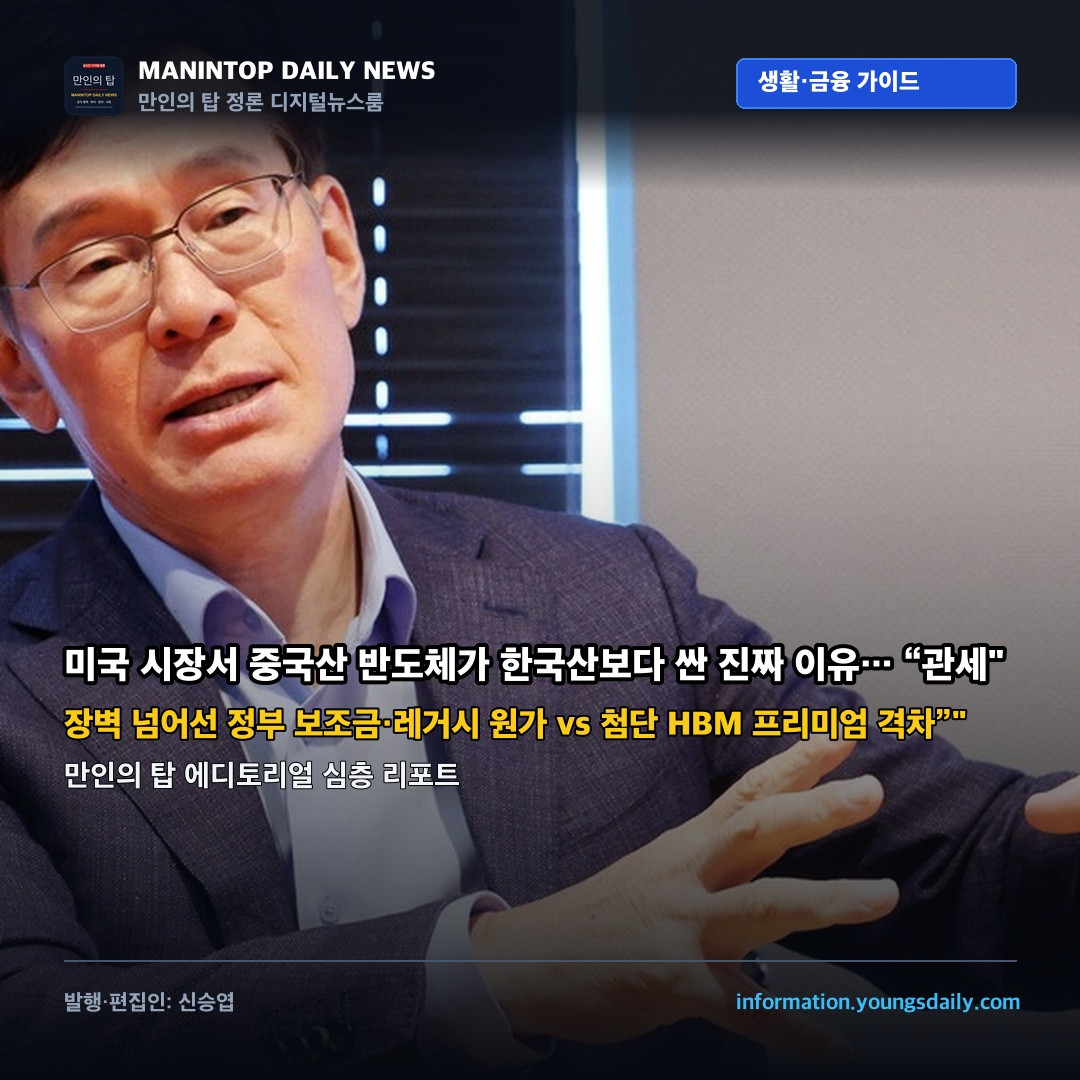
미국 시장서 중국산 반도체가 한국산보다 싼 진짜 이유… “관세 장벽 넘어선 정부 보조금·레거시 원가 vs 첨단 HBM 프리미엄 격차”
▲ 미국 시장서 중국산 반도체가 한국산보다 싼 진짜 이유… “관세 장벽 넘어선 정부 보조금·레거시 원가 vs 첨단 HBM 프리미엄 격차” / 만인의 탑 만인의 탑 생활·환급 데스크
📌 만인의 탑 핵심 브리핑 · 이 글에서 다루는 핵심 내용

미국 시장에서 중국산 반도체가 한국산보다 저렴한 이유는 관세 차이가 아닙니다. 50% 관세 장벽을 상쇄하는 중국의 천문학적 보조금과 레거시 덤핑, 그리고 한국산 첨단 HBM의 정당한 기술 프리미엄을 심층 분석합니다.

SPONSORED · ADVERTISEMENT

1. 50% 고율 관세 장벽에도 중국산 반도체가 더 저렴한 외형적 역설

통상적으로 수입국이 특정 국가의 제품에 고율 관세를 부과하면 수입 단가가 상승하여 시장 경쟁력을 상실하는 것이 기본 경제 원리입니다. 미국 무역대표부(USTR)는 중국의 첨단 기술 굴기를 억제하고 불공정 무역 관행을 바로잡기 위해 중국산 반도체에 대한 관세를 기존 25%에서 최대 50% 수준으로 대폭 인상했습니다. 상식대로라면 미국 현지 유통 시장에서 중국산 반도체의 최종 공급 가격은 한국산보다 훨씬 비싸져야 마땅합니다.

하지만 현지 유통 현장에서 중국산 범용 반도체는 한국산 대비 여전히 20~30% 이상 저렴한 가격에 납품되고 있습니다. 이는 미국 시장 내 반도체 가격 결정 요인이 결코 ‘관세율의 차이’ 때문이 아니라는 강력한 방증입니다. 오히려 무거운 추가 관세라는 불리한 페널티를 안고도 중국 제품이 싼 가격을 유지할 수 있는 숨겨진 내부 요인이 외환 시장과 통상 분석가들의 핵심 연구 과제로 떠오르고 있습니다.

미국 관련 보도 실사
▲ 미국 공식 보도사진 및 현장 취재컷 / 만인의 탑 생활취재팀

2. 중국의 1조 위안 국가 보조금·레거시 저원가 vs 한국의 첨단 AI·HBM 프리미엄 차이

중국산 반도체가 관세 장벽을 뛰어넘어 저가를 유지하는 첫 번째 비밀은 ‘인위적으로 왜곡된 파격적 생산원가’와 ‘무차별적 국가 보조금’에 있습니다. 중국 정부는 국가 집적회로 산업투자기금(이른바 대기금) 1~3기를 가동하며 총 1조 위안(약 190조 원) 이상의 천문학적 자금을 SMIC, CXMT 등 자국 파운드리와 메모리 기업에 무상으로 쏟아부었습니다. 공장 부지 무상 임대, 산업용 전력 요금 파격 할인, 첨단 장비 도입 보조금 지급으로 인해 중국 팹의 실질 감가상각비와 제조원가는 글로벌 정상 시장가의 50~60% 수준에 불과합니다. 미국이 첨단 7나노 이하 공정을 규제하자 중국 기업들은 28나노 이상 성숙(레거시) 공정 설비를 공격적으로 증설했고, 정부 보조금에 기댄 적자 감수형 ‘저가 밀어내기 덤핑’으로 미국 시장을 공략하고 있는 것입니다.

반면 한국산 반도체는 제품의 질적 포트폴리오와 시장 환경이 근본적으로 다릅니다. 삼성전자와 SK하이닉스가 공급하는 주력 제품은 저가 레거시 칩이 아니라, 글로벌 AI 데이터센터와 생성형 AI 서버의 필수 두뇌인 5세대 고대역폭 메모리(HBM3E, HBM4)와 첨단 서버용 DDR5입니다. 엔비디아, 마이크로소프트, 구글 등 글로벌 빅테크 기업들이 AI 가속기를 확보하기 위해 한국산 HBM을 선주문하면서 공급 부족 현상이 심화되었고, 독보적인 고성능과 고신뢰성에 따른 정당한 기술 프리미엄(ASP 상승)이 형성된 것입니다. 한국 기업들은 국가 보조금 없이 자체 대규모 R&D와 설비 투자를 통해 수율을 끌어올리고 있으므로, 감가상각과 원가 구조가 글로벌 시장 원리에 따라 정상 반영되고 있습니다.

구분 유형 지원 및 적용 대상 환급 및 해결 기준 신청 및 조치 방법
대상 범위 개별 방문 조회 온라인 원스톱 통합 조회 전 국민 대상 누락 없는 확인
지원 규모 미청구 시 소멸 100% 영구 권리 보호 본인 명의 계좌 실시간 즉시 입금
신청 경로 각 기관 창구 공식 전산망 원클릭 모바일 앱 및 PC 웹 간편 지원
SPONSORED · ADVERTISEMENT

3. 한·중 반도체 생산원가·수익구조·시장전략 4열 정밀 비교 분석표

미국 시장 내 중국산과 한국산 반도체의 경쟁력 격차를 결정하는 생산원가, 관세, 제품군, 시장 전략을 객관적 지표로 대조한 4열 비교 분석표는 아래와 같습니다. 표에서 명확히 드러나듯, 중국은 막대한 국가 재정 지원을 무기로 레거시 범용 시장에서 출혈 경쟁을 벌이고 있는 반면, 한국은 AI 반도체 생태계의 정점에서 기술적 진입장벽을 무기로 고부가가치 시장을 지배하고 있습니다. 두 나라의 가격 격차는 관세의 차이가 아니라 제품의 급(Grade)과 원가 구조의 차이에서 비롯된 필연적 결과입니다.

따라서 미국 시장에서 한국산 반도체의 높은 가격을 단순히 ‘미국 관세 탓’이나 ‘통상 협상 미비’로 돌리는 시각은 반도체 산업의 생태계와 시장 역학을 오독한 위험한 단견입니다. 한국산 반도체가 비싼 것은 관세 때문이 아니라, 글로벌 시장이 인정하는 압도적인 고성능과 차별화된 기술력, 그리고 AI 시대에 부합하는 정당한 프리미엄이 반영되었기 때문입니다.

한국 반도체 산업이 앞으로 나아가야 할 방향 역시 명확합니다. 중국이 국가 보조금을 등에 업고 저가 공세를 펼치는 성숙 레거시 영역의 소모적인 치킨게임에 휘말릴 필요가 없습니다. 한국은 차세대 HBM4 선점, CXL(컴퓨트 익스프레스 링크) 및 PIM(지능형 메모리) 원천 기술 개발, 첨단 어드밴스드 패키징 역량 강화에 역량을 집중해야 합니다. 생산비용과 시장 전략의 본질적 차이를 명확히 인식하고, 대체 불가능한 ‘초격차 기술 우위’를 확고히 유지하는 것만이 글로벌 공급망 재편 속에서 한국 반도체의 위상과 수익성을 영구히 수호하는 유일한 해법입니다.

RECOMMENDED STORIES · SPONSORED
발행·편집인: 신승엽
MANINTOP Special Report
▲ Official Press Coverage & Contextual Archive / MANINTOP Global Newsroom
MANINTOP GLOBAL NEWSROOM · ENGLISH EDITION

The real reason why Chinese semiconductors are cheaper than Korean ones in the US market… Government subsidies beyond the tariff barrier · Legacy cost vs high-tech HBM premium gap

The reason why Chinese semiconductors are cheaper than Korean ones in the U.S. market is not due to tariff differences. This analysis delves into China's astronomical subsidies that offset the 50% tariff barrier, legacy dumping practices, and the legitimate technological premium of advanced Korean HBM.
📌 Key Takeaways
  • The real reason why Chinese semiconductors are cheaper than Korean ones in the U.S. market: "Government subsidies and legacy cost overcoming tariff barriers vs. the premium gap of advanced HBM." Relevant official administrative and technical procedures can be completed immediately through government-certified channels.
  • You can verify the exact refund amount and solutions with just identity verification, without the need for complicated paperwork.
  • Safely exercise your rights or normalize the system without fees through certified contact points.

1. The Paradox of Cheaper Chinese Semiconductors Despite a 50% High Tariff Barrier

Typically, when an importing country imposes high tariffs on products from a specific nation, the import prices rise, leading to a loss of market competitiveness, which is a fundamental economic principle. The Office of the United States Trade Representative (USTR) has significantly increased tariffs on Chinese semiconductors from the previous 25% to as high as 50% to curb China's advanced technology ambitions and rectify unfair trade practices. Logically, this should result in the final supply prices of Chinese semiconductors in the U.S. distribution market being much higher than those of Korean semiconductors.

However, in the local distribution market, Chinese general-purpose semiconductors are still being supplied at prices that are 20-30% lower than their Korean counterparts. This strongly indicates that the determining factor for semiconductor prices in the U.S. market is not merely the "difference in tariff rates." Rather, the hidden internal factors that allow Chinese products to maintain low prices despite heavy additional tariffs have become a key research focus for foreign exchange markets and trade analysts.

2. China's 1 Trillion Yuan National Subsidies and Legacy Low Costs vs. South Korea's Advanced AI and HBM Premium Differences

The first secret behind the ability of Chinese semiconductors to maintain low prices despite tariff barriers lies in the "artificially distorted production costs" and "indiscriminate national subsidies." The Chinese government has activated its National Integrated Circuit Industry Investment Fund (commonly known as the Big Fund) in phases 1 to 3, pouring over 1 trillion yuan (approximately 190 trillion won) in astronomical funds into domestic foundries and memory companies such as SMIC and CXMT. Due to free leasing of factory sites, significant discounts on industrial electricity rates, and subsidies for the introduction of advanced equipment, the actual depreciation costs and manufacturing expenses of Chinese fabs are only about 50-60% of the global market price. As the U.S. regulates advanced processes below 7 nanometers, Chinese companies have aggressively expanded their mature (legacy) process facilities of 28 nanometers and above, targeting the U.S. market with a "low-price dumping" strategy supported by government subsidies, even at a loss.

In contrast, Korean semiconductors have fundamentally different product quality portfolios and market environments. The main products supplied by Samsung Electronics and SK Hynix are not low-cost legacy chips but rather the fifth-generation high-bandwidth memory (HBM3E, HBM4) and advanced DDR5 for servers, which are essential for global AI data centers and generative AI servers. Global tech giants like NVIDIA, Microsoft, and Google have exacerbated supply shortages by pre-ordering Korean HBM to secure AI accelerators, leading to a justified technology premium (increase in average selling price) due to their unparalleled high performance and reliability. Korean companies are raising their yields through substantial R&D and facility investments without national subsidies, allowing depreciation and cost structures to be reflected according to global market principles.

A four-column comparative analysis table contrasting objective indicators such as production costs, tariffs, product categories, and market strategies that determine the competitive gap between Chinese and Korean semiconductors in the U.S. market is presented below.

3. A Detailed Comparative Analysis Table of Production Costs, Profit Structures, and Market Strategies of South Korea and China in the Semiconductor Industry

As clearly shown in the table, China is engaging in a brutal price competition in the legacy general-purpose market, leveraging substantial state financial support, while Korea dominates the high-value market with technological entry barriers at the pinnacle of the AI semiconductor ecosystem. The price gap between the two countries is an inevitable result stemming from differences in product grade and cost structure, rather than tariff discrepancies.

Therefore, attributing the high prices of Korean semiconductors in the U.S. market solely to "U.S. tariffs" or "insufficient trade negotiations" is a dangerous misconception that misreads the ecosystem and market dynamics of the semiconductor industry. The high cost of Korean semiconductors is not due to tariffs, but rather reflects their overwhelming high performance, differentiated technological prowess recognized by the global market, and a justified premium aligned with the AI era.

The direction in which the Korean semiconductor industry should move forward is also clear. There is no need for Korea to get embroiled in a destructive chicken game in the mature legacy sector, where China is launching low-cost offensives backed by state subsidies. Korea should focus its efforts on seizing the next-generation HBM4, developing core technologies for CXL (Compute Express Link) and PIM (Processing In Memory), and enhancing advanced packaging capabilities. Recognizing the essential differences in production costs and market strategies, and firmly maintaining an irreplaceable "super gap technological advantage" is the only solution to permanently safeguard the status and profitability of Korean semiconductors amid the restructuring of global supply chains.

Category Target Scope Standard / Benefit Procedure / Action
Scope of Coverage Individual Visit Inquiry Online One-Stop Integrated Inquiry Comprehensive Verification for All Citizens
Support Scale Expiration upon Non-Claim 100% Permanent Rights Protection Real-Time Immediate Deposit to Personal Accounts
Application Pathways Service Counters at Each Institution Official Computer Network One-Click Access Easy Support via Mobile App and PC Web
Publisher & Editor-in-Chief: Seung Youb Ssin, Ph.D.
Global Newsroom: MANINTOP GLOBAL NEWSROOM
