MANINTOP GLOBAL NEWSROOM · SPECIAL EDITORIAL REPORT
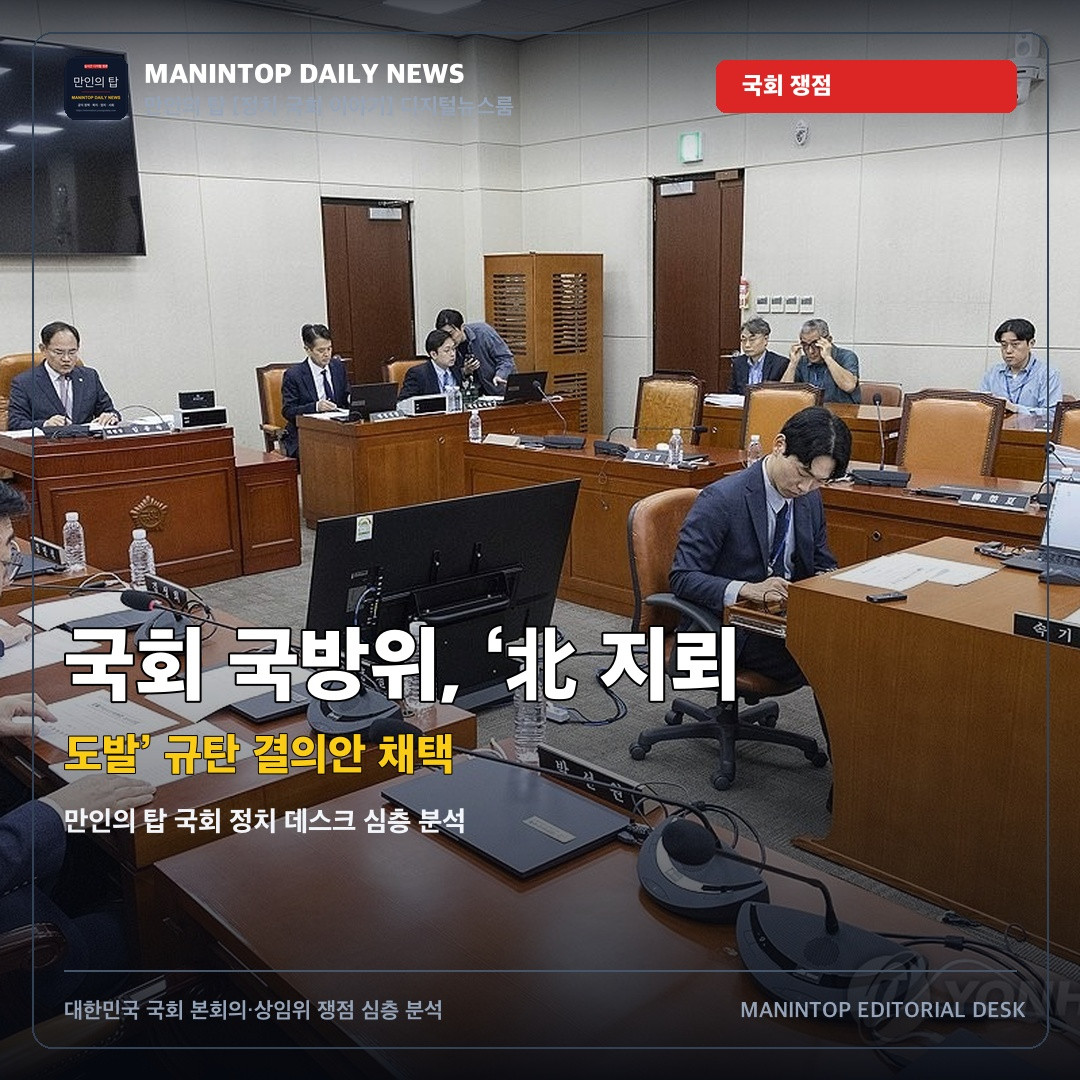
National Defense Committee adopts resolution condemning ‘North Korean landmine provocation’… Political watershed in the battle between the ruling and opposition parties
Reported by Alex Shin, Ph.D. | Publisher & Editor-in-Chief, MANINTOP DAILY NEWS
📌 Key Takeaways (Executive Summary)
- Key Issues Emerge: The National Assembly's National Defense Committee's adoption of a resolution condemning North Korea's landmine provocation emerged as a major standing committee issue in the regular National Assembly.
- Conflict between the ruling and opposition parties: Differences in positions between the ruling and opposition leaders create a cooling atmosphere in the political situation.
- Future legislative direction: Announcement of follow-up verification through review of related bills and inquiries from government audit
In the National Assembly and the political world, a confrontation between the ruling and opposition parties is sharply forming over the issue of ‘National Defense Committee adopts resolution condemning ‘North Korean land mine provocation’’, and political tension is rising. This issue goes beyond a simple battle and is evaluated as a major watershed that will determine the direction of future National Assembly standing committee reviews and major legislative tasks.
1. Origin of the issue and background of political issue
The direct impetus for the issue of ‘National Defense Committee adopts resolution condemning ‘North Korean landmine provocation’’ to become the center of public debate came from official announcements from the government and related organizations, and a war of words at major meetings of the National Assembly. According to on-site coverage by multiple accredited media outlets, including Chosun Ilbo, Yonhap News, and MBC News, this incident has quickly emerged as a serious issue surrounding national administrative principles and the legitimacy of the exercise of authority, beyond simple differences in political opinion.
In particular, as the direct statement ‘Resolution condemning North Korean land mine provocations’, which became the catalyst for the controversy, was made public, the roots of the situation are closely connected to institutional issues that have been going on beneath the surface. In the past, small and large frictions arose during similar bill review or personnel verification processes, but this time, the schedule of the regular National Assembly and the strategic decisions of the ruling and opposition party leaders intertwined, turning into an unprecedented and steep confrontation. From the perspective of high school students or general readers, this is not just a fight for position or an argument, but a key incident that measures the independence of law enforcement agencies and the extent to which the National Assembly's power to check should extend.
2. Comparison of positions and issues of the ruling and opposition parties
The conflict between political parties surrounding this issue is due to the ‘National Defense Commission’s adoption of a ‘resolution condemning North Korean landmine provocations’… They are running on tight parallel lines, converging on the issues of “investigation delay investigation” and No’s departure. The ruling party emphasizes that it is a legitimate exercise of command authority as stipulated by the Constitution and current laws and that it is an inevitable measure to establish the principles of public service and society. The logic is that unwavering law enforcement must come first in order to stably complete national tasks and establish public order.
In response to this, a strong counterargument is being raised that the investigation is being delayed, and the opposition party is defining this as an abuse of power and administrative convenience, and is preparing to push for an intensive inquiry into pending issues at the National Assembly level and a government investigation. Criticism is being raised that this is an unreasonable move that bypasses the democratic deliberation process and could set a bad precedent for similar cases in the future. A systematic comparison of the key arguments and legal issues raised by both sides is as follows.
| Category |
ruling party stance |
Opposition position |
Consensus and Outlook |
| basic admission |
Compliance with the principles of national affairs and the rule of law |
Criticism and checks on government policies |
Standing committee standoff continues |
| legal issues |
Emphasis on compliance with current legal procedures |
Allegations of abuse of power and unconstitutionality |
Start legal review |
| political situation |
Call for separate handling of public livelihood issues |
Promoting hard-line struggle and hearings |
Coordinating the meeting of floor leaders of the ruling and opposition parties |
| follow-up measures |
System improvement plan passed at the regular National Assembly |
Special committee composition and thorough verification |
Seeking compromise negotiations |
3. Prospects and points to watch for passing the standing committee and plenary session
So, what kind of institutional procedures will the National Assembly go through in the future regarding this issue of ‘National Defense Committee adopts resolution condemning ‘North Korean land mine provocation’’? The agenda is submitted to an official meeting of the relevant standing committees (Legislative and Judiciary Committee, Public Administration and Security Committee, Steering Committee, etc.) and undergoes detailed questioning of the ministers and officials in charge. If new documents or evidence are presented during the question-and-answer process, which will remain permanently in the National Assembly minutes, political tension is expected to heat up further.
What is noteworthy is that this type of workshop in Yeouido has a direct and indirect impact on the lives of ordinary citizens and high school youth. If the National Assembly is preoccupied with political strife and the review of bills and budget plans related to people's livelihood is pushed to the back of the priority list, the schedule for youth support measures, improvement of the educational environment, and public infrastructure investment for stabilizing living prices will be delayed one after another. This is why political news affects 'me and my family's taxes and future environment.'
4. Future negotiation schedules within the ruling and opposition parties and points to watch for in political affairs
Conflict and checks are a natural process in a democratic society, but the end of conflict must always result in reasonable compromise and promotion of the people's rights. Even looking at past historical precedents, the extreme war of attrition ultimately paid a heavy price in terms of increased administrative costs and national fatigue.
The political world must focus its capabilities on restoring public trust through transparent disclosure of information and strict institutional procedures, regardless of partisan strategy. When mature responsible politics are implemented that accept the other party's legitimate opinions while upholding principles based on common sense and natural order, this situation can become an opportunity for our democracy to take a leap forward, rather than a swamp of conflict.




0 댓글