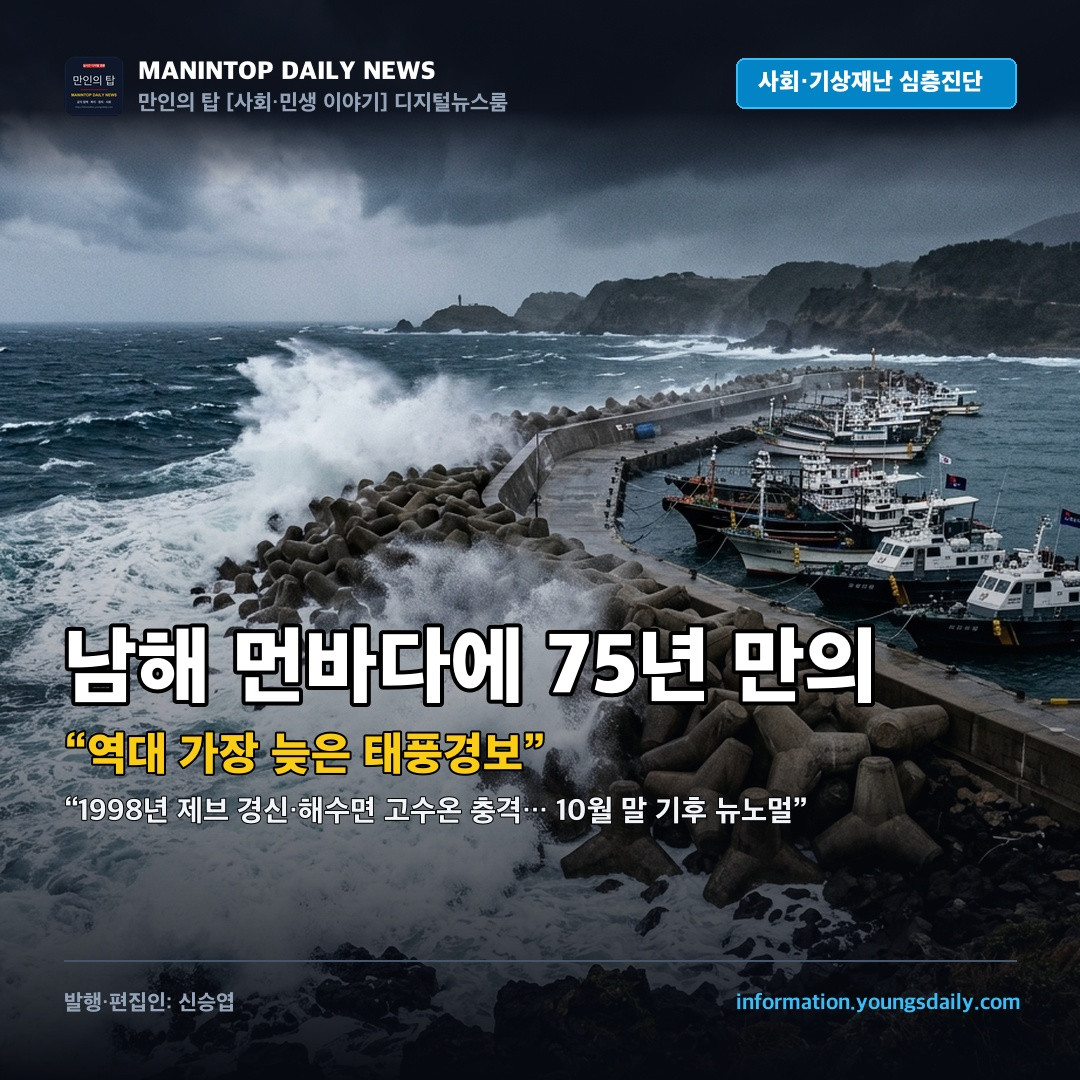
▲ 제주도 남쪽 먼바다와 남해동부 바깥먼바다에 75년 만의 최늦단 태풍경보가 발효된 가운데 집채만 한 너울성 파도가 해안 테트라포드 방파제를 강타하고 있다. ⓒ 만인의 탑
10월 하순 북상한 제30호 태풍 '참피(CHAMPI)'로 인해 제주 남쪽 바깥먼바다와 남해동부 바깥먼바다에 공식 '태풍경보'가 발효되며 대한민국 근대 기상 관측망이 구축된 1951년 이래 75년 만에 역대 가장 늦은 태풍으로 기록되었습니다. 종전 최늦단 기록이었던 1998년 태풍 '제브(10월 16~18일)'를 9일 이상 늦춘 이번 사태는, 과거 10월 중순이면 태풍이 완전히 소멸하던 한반도 기상 공식이 완전히 깨지고 '10월 말 태풍 경보'라는 전례 없는 기후 뉴노멀의 시대에 진입했음을 극명하게 증명하고 있습니다.
1. 1998년 '제브' 넘은 75년 만의 최늦단 태풍경보… 남해 먼바다의 기상학적 이변
기상청 통보문에 따르면 제30호 태풍 '참피'는 중심기압 980hPa, 최대 풍속 초속 30m 안팎의 강한 세력을 유지한 채 남해동부 바깥먼바다 해상을 통과했습니다. 이 과정에서 제주 남쪽 먼바다와 남해 먼바다 일대에 태풍경보가 연속 발효되었습니다. 이는 1951년 기상청 통계 작성 이후 무려 75년 만에 가장 늦은 시기에 우리나라 해상에 직접적인 태풍경보를 내린 역사적 사건으로 공인되었습니다.
남해 먼바다 해상에는 최고 7m에서 10m에 달하는 집채만 한 폭풍해일과 너울성 고파가 들이닥쳐 연근해 항해 선박 수천 척이 긴급 피항했습니다. 제주와 부산, 통영, 여수를 잇는 주요 연안 여객선 뱃길이 전면 통제되었으며 해안가 저지대에는 파도가 방파제를 넘는 월파 현상이 발생해 해경과 소방당국이 비상 경계 근무에 돌입하는 등 가을철 늦은 긴장이 고조되었습니다.
기상·방재 분석 영역
현장 관측치 및 핵심 사실관계
기상학적 원인 및 메커니즘
제도적·사회적 시사점
기상 관측 신기록 달성
1951년 근대 관측 이래 75년 만에 10월 하순 남해동부 바깥먼바다 태풍경보 발효
1998년 태풍 '제브(10월 16~18일)'를 9일 이상 늦춘 최늦단 기록 경신
과거 10월 중순이면 끝나던 한반도 가을 태풍 시즌의 공식적 연장 확인
발생 원인 및 해수면 고수온
북서태평양 및 한반도 남쪽 해역 해수면 온도 26~27℃ 장기 유지
북쪽 시베리아 찬 공기 남하 지체와 북태평양고기압 수축 지연의 중첩
지구 온난화로 인한 해양 열용량 급증이 늦가을 태풍을 북상시키는 에너지원 작용
남해안·제주 현장 피해 영향
최대 순간풍속 30m/s 강풍 및 최고 7~10m 집채만 한 너울성 폭풍해일 발생
선박 수천 척 항포구 결속 피항 및 연안 여객선 뱃길 전면 통제
가을철 수확기 농작물 낙과 및 연안 가두리 양식장 파손 등 복합 농수산 피해
국가 해양 방재 기준 개편
10월 말~11월 초 태풍 상례화 대비 항만 테트라포드 설계 파고 상향 조정
만조 수위와 폭풍해일이 겹치는 복합 해양재난 대비 해안가 배수 펌프장 확충
기후위기 시대에 걸맞은 사계절 전천후 해양 재난안전 인프라 법제화 시급
2. 26도 넘는 해수면 고수온 장기화… 기후 뉴노멀이 부른 가을 태풍의 통로
이번 늦가을 태풍의 이례적 북상 배후에는 전 지구적 온난화로 인한 북서태평양 해수면의 '이상 고수온 현상'이 자리 잡고 있습니다. 통상 10월 하순이 되면 한반도 주변 수온이 22℃ 이하로 떨어져 태풍이 북상하더라도 에너지를 잃고 빠르게 소멸합니다. 그러나 올해는 남해상과 필리핀 북동부 해역의 표층 수온이 태풍 유지 임계치인 26~27℃ 이상을 장기간 유지하면서 태풍이 에너지를 잃지 않고 위도 30도선 이상까지 밀고 올라왔습니다.
여기에 북쪽 시베리아 찬 대륙고기압의 남하가 예년보다 일주일 이상 지연되고, 북태평양고기압의 수축이 늦어지면서 태풍이 남해 코앞까지 직진할 수 있는 거대한 '기압의 고속도로'가 열렸습니다. 기상 전문가들은 이러한 해양 열용량 증대가 일시적 현상이 아니라 온난화가 정착된 한반도 해역의 구조적 변화라며, 향후 '11월 초 한반도 상륙 태풍'의 출현도 결코 배제할 수 없다고 경고합니다.
▲ 남해안 항포구에 태풍경보 속 긴급 피항한 어선들을 단단히 고정하고 있는 주철 볼라드와 선박 계류 로프. ⓒ 만인의 탑
3. 해양 방재 인프라의 전면 개편과 가을 농수산물 수호 과제
역대 가장 늦은 태풍경보는 국가 재난 방재 시스템의 기준점을 전면 재조정해야 한다는 준엄한 숙제를 남겼습니다. 특히 10월 말은 가을철 주요 작물인 벼와 배추, 무의 본격 수확기이자 마늘과 양파 등 월동 작물의 파종기여서, 늦가을 태풍에 의한 침수와 강풍 피해는 한 해 농업 경제에 괴멸적 타격을 입힙니다. 농어업 재해보험의 보상 기한과 심사 매뉴얼을 11월 중순까지 확대 개편하는 법적 정비가 시급합니다.
아울러 연안 항만의 테트라포드 방파제 설계 파고 기준을 현행 50년 빈도에서 100년 빈도로 상향하고, 만조 수위와 태풍 폭풍해일이 겹치는 복합 침수에 대비해 해안가 도심 배수 펌프장의 배수 용량을 2배 이상 증설해야 합니다. 기후변화는 이미 계절의 경계를 허물고 있습니다. 관행적인 여름철 방재 체제를 탈피하여 연중 365일 닥칠 수 있는 이상 기후 재난에 선제적으로 대응하는 국가 총력 방재 체계를 서둘러 완성해야 합니다.
▲ Colossal storm surges crash violently over coastal concrete tetrapods as the latest recorded typhoon warning in modern history takes effect across the South Sea. ⓒ MANINTOP Global Newsroom
The Korea Meteorological Administration has officially issued an unprecedented typhoon warning across the outer southern waters and offshore Jeju Island due to Typhoon Champi, marking the latest recorded typhoon to impact South Korean waters in modern history since 1951. Surpassing the previous benchmark established twenty-eight years ago by Typhoon Zeb in mid-October 1998, this extraordinary late-season development confirms that climate change is fundamentally dismantling traditional seasonal boundaries, ushering in an unprecedented climate new normal.
1. Breaking the 1998 Zeb Record: A Historic Meteorological Milestone
According to national meteorological bulletins, Typhoon Champi maintained a central pressure of 980 hectopascals and maximum sustained winds of thirty meters per second as it swept across the outer waters of the South Sea. The resulting emergency warning represents the latest operational typhoon alert ever dispatched across Korean marine zones since official records commenced in 1951, rewriting longstanding historical records.
The storm generated colossal marine swells ranging between seven and ten meters, forcing thousands of commercial fishing vessels and coastal trawlers to seek emergency harbor mooring. Passenger ferry connections linking Jeju, Busan, Tongyeong, and Yeosu were suspended, while high-velocity storm waves breached coastal tetrapod embankments, prompting regional coast guard and emergency responders to activate emergency watch protocols.
Analytical Dimension
Observational Findings
Underlying Drivers
Systemic Implications
Historical Meteorological Record
First typhoon warning issued in late October across the southern offshore waters in seventy-five years
Surpassing the previous 1998 record set by Typhoon Zeb by more than nine days
Confirming the structural extension of South Korea's autumn cyclone season into late fall
Ocean Heat & Atmospheric Triggers
Sea surface temperatures maintaining thermal thresholds between 26 and 27 degrees Celsius
Delayed southward progression of continental cold fronts coinciding with persistent marine warmth
Demonstrating how elevated marine heat reservoirs fuel intense storm trajectories late in the year
Coastal & Agricultural Damage
Peak wind gusts reaching thirty meters per second alongside ten-meter storm swells
Forced nationwide harbor mooring of commercial fleets and total suspension of coastal ferries
Compounding damages across late autumn harvest crops and offshore aquaculture pens
Maritime Defense Infrastructure
Elevating tetrapod breakwater engineering baselines against late-season coastal surges
Mandating comprehensive modernization of year-round national disaster legislation
2. Elevated Marine Thermal Capacity and Atmospheric Corridors
Meteorological scientists attribute this unprecedented late-autumn development to chronic marine warming across the northwestern Pacific Basin. Historically, sea temperatures surrounding the Korean Peninsula drop below twenty-two degrees Celsius by late October, dissipating incoming cyclonic systems. However, baseline surface temperatures throughout regional waters remained between twenty-six and twenty-seven degrees, supplying sustained thermal fuel that preserved the storm's cyclonic momentum.
This marine heat reservoir coincided with an anomalous delay in the expansion of cold continental Siberian air masses and the slow retreat of the North Pacific subtropical anticyclone. This atmospheric configuration carved an open migratory highway straight toward the southern coastline. Experts caution that these compounding thermal dynamics represent structural shifts, warning that November typhoon occurrences must now be incorporated into national disaster contingency modeling.
▲ Heavy-duty cast iron mooring bollards securing maritime vessels against extreme offshore storm surges along the southern coastline. ⓒ MANINTOP Global Newsroom
3. Modernizing Maritime Breakwater Codes and Agricultural Safety Nets
This historic weather event necessitates a thorough overhaul of South Korea's maritime disaster infrastructure. Late October is an essential harvesting period for key autumn crops including rice, cabbage, and wintering root vegetables, meaning that unseasonal deluge and gale-force gusts inflict severe socioeconomic trauma across farming communities. Statutory frameworks governing agricultural disaster insurance must be recalibrated to encompass late-fall typhoon events.
Furthermore, national engineering baselines for tetrapod breakwaters must be upgraded from fifty-year to one-hundred-year storm frequencies, coupled with doubled pumping capacities across coastal drainage facilities to counter compound storm surge flooding. Climate disruption has effectively dissolved traditional calendar milestones. South Korea must transcend seasonal response models to institutionalize a permanent, year-round disaster defense network capable of mitigating unpredictable climate shocks.
Recommended Deep-Dive Investigations TOP 3
MANINTOP GLOBAL
Computer Programmer who love programming.
Computer Programmer Who love Riding Bicycle.
Computer Programmer who love trip in abroad.
Computer Programmer who love studying about programming
- even if sometimes it's very boring.
Computer Programmer who love talking with person.
- I love communication with person.
1월이 시작되면 감기는 이미 우리 곁에 와 있습니다. 2월, 3월, 4월까지 이어지는 추위와 건조함은 코와 목을 가장 먼저 공격합니다. 아침에 일어나자마자 막혀 있는 코. 계속 흐르는 콧물. 괜히 칼칼해지는 목. 이 증상은 “시작”일 뿐입니다. 한 번 무너지면 일주일, 길면 한 달까지 끌고 갑니다. 약을 먹으면 잠깐 괜찮아집니다. 하지만 며칠 뒤 또 반복됩니다. 왜일까요? 감기는 ‘치료’의 문제가 아니라 ‘관리’의 문제이기 때문입니다. 대부분은 감기가 오고 나서 약을 찾습니다. 하지만 진짜 중요한 건 감기가 오기 전에 코와 목을 지키는 것입니다. 건조한 실내 공기, 차가운 바깥 공기, 눈에 보이지 않는 세균. 코와 목은 매일 공격받고 있습니다. 지긋지긋하죠! 그런데도 우리는 아무 준비 없이 버티고 있습니다. 이번 겨울도 그렇게 보낼 건가요? 사실 방법은 어렵지 않습니다. 코를 깨끗하게 관리하고, 목을 따뜻하게 보호하고, 점막을 촉촉하게 유지하고, 기관지를 미리 관리하고, 외부 공기를 차단하는 것. 이 다섯 가지만 꾸준히 해도 감기약 없이 겨울을 보내는 것이 충분히 가능합니다. 🔥 이제부터 그 방법을 하나씩 살펴보겠습니다. 🔥 1. 코와 목을 먼저 관리해야 하는 과학적 이유 감기의 대부분은 코 점막에서 시작됩니다. 국제 학술지 Nature Reviews Microbiology 와 Journal of Allergy and Clinical Immunology 에 실린 호흡기 감염 관련 연구들에서는, 감기 바이러스가 비강 상피세포에 먼저 부착해 증식한다는 점을 설명하고 ...
리모델링사업이 진행 중인 아파트를 매매할 때 “계약금 10%를 언제까지 내야 하느냐”는 질문이 특히 많이 나옵니다. 이주공고(이주 안내)가 7~11월쯤이라고 들으면, 그 시점에 맞춰 계약금도 움직일 것 같아서 더 헷갈리기 쉽습니다. 하지만 실제 납부기한은 ‘이주공고가 언제냐’만으로 자동 결정되지 않는 경우가 많습니다. 1) 계약금 10% 납부기한: 결국 ‘문서에 적힌 일정’이 기준 계약금 10%를 언제까지 납부해야 하는지는, 내가 서명하는 매매계약서(특약 포함) 와 사업주체/조합이 제시한 공고·안내문 에 적힌 납부 일정이 기준이 됩니다. 실제 공고문에서는 분양대금 납부의 큰 틀(계약금→중도금→잔금)을 먼저 안내하고, 상세 일정은 별도 표나 유의사항으로 제시하는 방식이 흔합니다. 또, 계약서 문구에 따라 지급 시점이 조건부로 설정될 수도 있습니다. 예를 들어 한 사례 소개 자료에서는 용역계약서에 잔금(10%) 지급시기가 “사업승인 후”로 기재되어 있었다는 점이 언급됩니다. 이런 식으로 ‘사업 단계’와 지급을 연동하는 문구가 들어가면, 질문의 답은 계약서 문구를 확인해야만 확정됩니다. 관련 내용은 링크 에서 문구 사례를 확인할 수 있습니다. 2) 입주자모집공고에서 확인되는 ‘납부 순서’와 잔금 마감 시점 공고문에 적힌 문구를 보면, 납부 순서와 잔금 마감에 대한 기준이 비교적 명확하게 제시되는 경우가 있습니다. 예를 들어 한 입주자모집공고에는 “분양금액(주택가격)은 계약금, 중도금, 잔금의 순서로 납부”하며 “잔금은 입주(열쇠 수령일) 전에 완납”해야 한다고 안내되어 있습니다. (문구 확인: 링크 ) 이 문구가 의미하는 바는 최소 2가지입니다. 분양/공급 형태의 문서에서는 ‘계약금→중도금→잔금’ 흐름이 공식적으로 안내될 수 있습니다. 잔금은 “입주(열쇠 수령)” 이전에 완납해야 한다는 마감 기준이 문서에 적혀 있을 수 있습니다. 다만, 위 공고문 문구는 잔금 마감에 대한 기준을 보여주지만, 계약금 10%의...
윤석열 전 대통령 탄핵 인용 소식을 접하면, 가장 궁금한 지점은 ‘헌재가 정확히 무엇을 위헌·위법으로 봤는가’입니다. 또한 탄핵과 별개로 진행되는 형사재판(내란 우두머리 혐의 등)이 어디까지 왔는지도 함께 정리할 필요가 있습니다. 아래 내용은 제공된 기사/게시물 스니펫과 링크에서 확인되는 범위만 모아, 일반인이 흐름을 이해하기 쉽게 정리한 것입니다. 1) 탄핵 인용 관련: 스니펫에서 확인되는 ‘판단의 골격’ 제공된 근거 중 조국혁신당 사이트에는 헌법재판소가 윤석열 탄핵 심판에서 “피청구인의 위헌·위법행위는 국민 신임 …”이라는 취지로 판단했다는 문장이 인용돼 있습니다( 링크 ). 이 인용문만 놓고 보면, ‘위헌·위법행위’가 있었는지와 그로 인해 ‘국민의 신임’이 어떻게 평가됐는지가 핵심 축으로 소개됩니다. 다만 질문에서 요청하신 세부 항목, 즉 비상계엄 선포 자체를 문제 삼은 구체적 이유, 계엄 이후 조치(포고령, 국회 통제 등)의 어떤 지점이 헌법 위반인지, 국회의 권한행사 방해 및 정치활동 제약을 어떤 논리로 판단했는지 등은, 이번에 제공된 근거의 제목/스니펫만으로는 조항·사실관계·판단 구조가 그대로 제시돼 있지 않습니다. 따라서 이 글에서는 ‘헌재가 무엇을 문제 삼았다’는 세부 리스트를 단정적으로 재구성하기보다, 현재 확인 가능한 문구 수준의 요약(위헌·위법행위 → 국민 신임의 문제로 평가)까지만 적습니다. 만약 헌재 결정문 전문(주문 및 이유)이 추가로 확인되면, 그때는 문장 단위로 ‘어떤 행위’와 ‘어떤 헌법 원리/조항’이 연결되는지(예: 권력분립, 국회의 권한, 정치적 기본권 등) 구조화해 정리하는 것이 가장 정확합니다. 2) 형사 절차(내란 혐의) 관련: 체포영장과 1심 선고 언급 탄핵 심판과 별도로, 12·3 비상계엄 사태로 내란 혐의를 받는 윤석열 대통령에 대해 2024년 12월 31일 체포 영장이 발부됐다는 BBC 보도가 있습니다( 링크 ). 해당 보도는 ‘현직 대통령’에 대한 체포영장 발부라는 점을 함께 언급합니다. 또...





0 댓글